


The History of the Nürburgring: A Century of the Green Hell
Imagine a ribbon of asphalt so dangerous that it claimed five lives during its very first decade of operation. The Nürburgring isn't just a race track. It's a chaotic, beautiful, and terrifying masterpiece of engineering. You likely already respect it as the ultimate proving ground, but the deep Nürburgring history reveals a story far more complex than just lap times. It's the one place where a single second can define a brand's entire legacy.
Understanding this evolution shouldn't feel like reading a dusty textbook. We've stripped back the confusing layouts and technical clutter to bring you the raw story of this German icon. You'll learn exactly why Sir Jackie Stewart dubbed it the "Green Hell" in 1968 and how the track evolved from a September 1925 public works project into a global cultural phenomenon. We're breaking down the timeline from the June 18, 1927 opening ceremony to the high-stakes arena it is today. Let's look at the design that changed racing forever.
Key Takeaways
- Trace the 1920s origins of the Eifel’s most ambitious project. See how a local works program birthed a global racing legend.
- Uncover the "Green Hell" legacy. Experience the danger and drama that defined Jackie Stewart’s most iconic racing era.
- Dive into Nürburgring history to master the evolution of the Nordschleife. Understand why it remains the ultimate benchmark for modern performance.
- Learn the "Touristenfahrten" tradition. Discover how to take your own road-legal vehicle onto the world’s most fearsome asphalt.
- Explore the technical mastery behind the world’s premier industry pool. See why every modern supercar is forged in the Eifel mountains.
The Birth of a Legend: Building the Nürburgring (1925-1939)
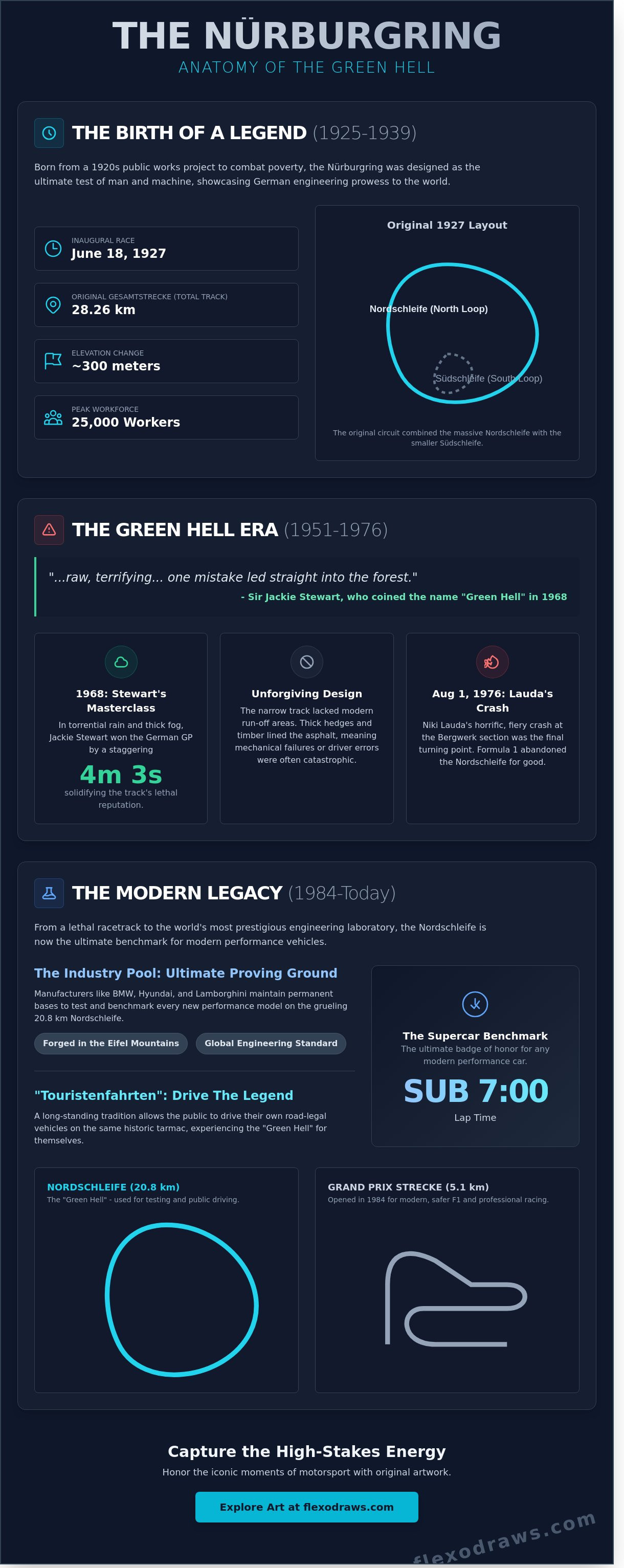
The Nürburgring history began as a bold solution to a regional crisis. In 1925, the Eifel region struggled with extreme poverty and high unemployment. German officials responded by commissioning a massive public works project to construct a world-class racing venue that would bring jobs and prestige to the area. The Nürburgring is a 28-kilometre mountain circuit designed to showcase German engineering. It was built to be the ultimate test for both man and machine. The original design featured two primary sections: the massive Nordschleife (North Loop) and the smaller Südschleife (South Loop). When the first engines roared during the inaugural race on June 18, 1927, the track instantly became the most challenging circuit in Europe. It was a technical marvel that demanded total respect from every driver who dared to enter the gates.
The Birth of the Nordschleife
Constructing the Nordschleife required an immense manual effort. Over 25,000 workers labored at the peak of the project to carve the track through the rugged Eifel landscape. They moved mountains of earth to create a circuit with nearly 300 metres of elevation change. This topography created a chaotic, high-speed experience unlike anything else on the continent. For a comprehensive overview of the track's evolution and various configurations, you can reference the Nürburgring on Wikipedia. The result was a vibrant, dangerous, and iconic stretch of asphalt that remains the gold standard for performance testing today.
The Silver Arrows Era
The years leading up to 1939 belonged to the legendary Silver Arrows. Mercedes-Benz and Auto Union used the Nürburgring as their primary testing ground, perfecting the world's fastest Grand Prix cars. These machines were technical masterpieces of their time, pushing the limits of pre-war technology. The circuit's punishing layout forced engineers to innovate, creating a pre-war era of absolute dominance. It wasn't just about speed; it was about mechanical integrity. The track's brutal nature ensured that only the most premium engineering survived the Eifel mountains. This era cemented the Nürburgring history as the spiritual home of high-performance racing, a legacy that still inspires automotive art and culture today.
The Green Hell: Danger, Drama, and the Jackie Stewart Era
Post-war reconstruction brought the Eifel circuit back to life. Formula 1 returned to the mountains in 1951. The track was legendary but lethal. Racing technology evolved rapidly. Speeds climbed. The Nordschleife stayed the same. It was a narrow ribbon of tarmac draped over 1,000 feet of elevation change. This period defined Nürburgring history as a test of survival as much as speed. Drivers faced a brutal landscape where mechanical failure usually meant a catastrophic accident.
Why Jackie Stewart Called it the Green Hell
Jackie Stewart coined the famous nickname in 1968. He viewed the 14.1-mile loop as a terrifying trap. The 1968 German Grand Prix solidified this reputation. Stewart battled through thick fog and torrential rain that reduced visibility to near zero. He won the race by a staggering 4 minutes and 3 seconds. It was a masterclass in a chaotic environment. The track lacked modern run-off areas. Only thick hedges and heavy timber lined the narrow asphalt. One mistake led straight into the forest. It was raw. It was terrifying. It was the Green Hell.
The 1976 Crash and the End of an Era
The danger peaked on August 1, 1976. Niki Lauda famously campaigned for a boycott due to safety concerns. His fears were realized at the Bergwerk section. Lauda's Ferrari hit the embankment and erupted in a massive fireball. Four fellow drivers stopped to pull him from the burning wreckage. This incident served as the final turning point for the sport. Formula 1 abandoned the original loop. The modern Grand Prix Strecke opened in 1984 to provide a controlled, safe environment for high-speed competition. You can still capture that high-stakes energy with original artwork that honors these iconic racing moments. The Nordschleife remains a vibrant, chaotic beast, but the era of F1 gladiators on the full loop ended in the smoke of 1976.
The Modern Legacy: Engineering Benchmarks and Iconic Track Art
The Nürburgring history has evolved from a dangerous racing circuit into the world's most prestigious engineering laboratory. Today, the Nordschleife serves as the ultimate industry pool. Major manufacturers like BMW, Hyundai, and Lamborghini maintain permanent bases at the track. They use the 20.8-kilometer loop to benchmark every new performance model. It's a brutal environment. The track remains accessible through the Touristenfahrten tradition. This allows fans to drive their own road-legal vehicles on the same legendary tarmac that defined generations of motorsport.
The Nordschleife as an Engineering Benchmark
The sub-7-minute lap time is the ultimate badge of honor for modern supercars. It's a benchmark that proves a vehicle's total capability. With 73 distinct turns and over 300 meters of elevation change, the track provides a comprehensive test. It pushes suspension, braking, and cooling systems to their absolute limits. If a car can handle the Karussell and the Fuchsrohre, it can handle anything. Manufacturers don't just come here for marketing. They come for the data that only the Green Hell provides.
Why the Nürburgring Map is an Iconic Art Piece
The track layout is a masterpiece of graphic design. Its "coiled snake" silhouette is a global symbol for automotive passion and high-end decor. It represents a shared history of speed and daring. Fans across the country display this heritage through iconic A3 Art Prints that capture the circuit’s complex geometry. A premium semi-gloss poster of the map acts as a bold statement piece for a garage or home office. These prints offer a vibrant, professional finish that mass-produced posters can't match. It's about celebrating the craft of racing through original artwork. PUT UP SOME ART.
Own the Legend of the Nordschleife
The Nürburgring remains the ultimate test of human endurance and automotive engineering. Since the first stone was laid in 1925 by over 25,000 workers, this circuit has defined the limits of speed. It survived the 1968 era when Jackie Stewart braved the fog to win by four minutes, forever branding it the Green Hell. Today, the 12.9 mile North Loop continues to serve as the definitive benchmark for every modern performance car. This century of Nürburgring history isn't just about lap times; it's about the soul of racing. You've followed the story from the 1920s to the modern engineering era. Now, it's time to bring that intensity into your own space with premium design.
PUT UP SOME ART: Explore the Nürburgring Track Map Collection. These are original racing circuit designs by Flexo Draws. Every print uses premium semi-gloss paper to ensure the colors stay vibrant and the lines stay sharp. It's bold, iconic art for fans who value the heritage of the track. Don't let your walls stay empty. Grab a piece of the Green Hell and keep the legacy alive in your home.
Frequently Asked Questions
What is the history of the Nürburgring?
The Nürburgring history began on September 27, 1925, when construction started in the Eifel mountains. Designed by Gustav Eichler, the project cost 14.1 million Reichsmarks and employed 25,000 workers. It opened on June 18, 1927, with Rudolf Caracciola winning the first motorcycle race. This iconic circuit remains the world's most demanding test of driver skill and engineering. Every corner of this German landmark tells a story of 97 years of racing heritage.
Why is the Nürburgring called the Green Hell?
Jackie Stewart coined the "Green Hell" nickname after winning the 1968 German Grand Prix. He finished the race 4 minutes ahead of the field despite heavy rain and thick fog. The name describes the 22.8 kilometer Nordschleife and its dense, unforgiving forest surroundings. With 154 corners and a 300 meter elevation change, it's a brutal masterpiece of engineering. Our bold designs capture this chaotic, high speed energy for your walls.
How long is the original Nürburgring track?
The original combined track spanned 28.265 kilometers when it first opened in 1927. This massive layout featured the 22.810 kilometer Nordschleife and the 7.747 kilometer Südschleife. Modern configurations changed significantly after the 1982 construction of the new Grand Prix circuit. Today's Nordschleife measures 20.8 kilometers for standard lap timing purposes. It's an iconic distance that defines the Nürburgring history for fans and artists alike.
Can you still drive on the Nürburgring today?
You can drive the Nordschleife during Touristenfahrten sessions held throughout the year. The track operates as a public toll road under German traffic law when not hosting official races. Drivers must bring road legal vehicles and valid licenses to experience the 73 turns for themselves. It's a premium experience for any racing enthusiast. Celebrate your own journey through the forest with our original artwork. PUT UP SOME ART.